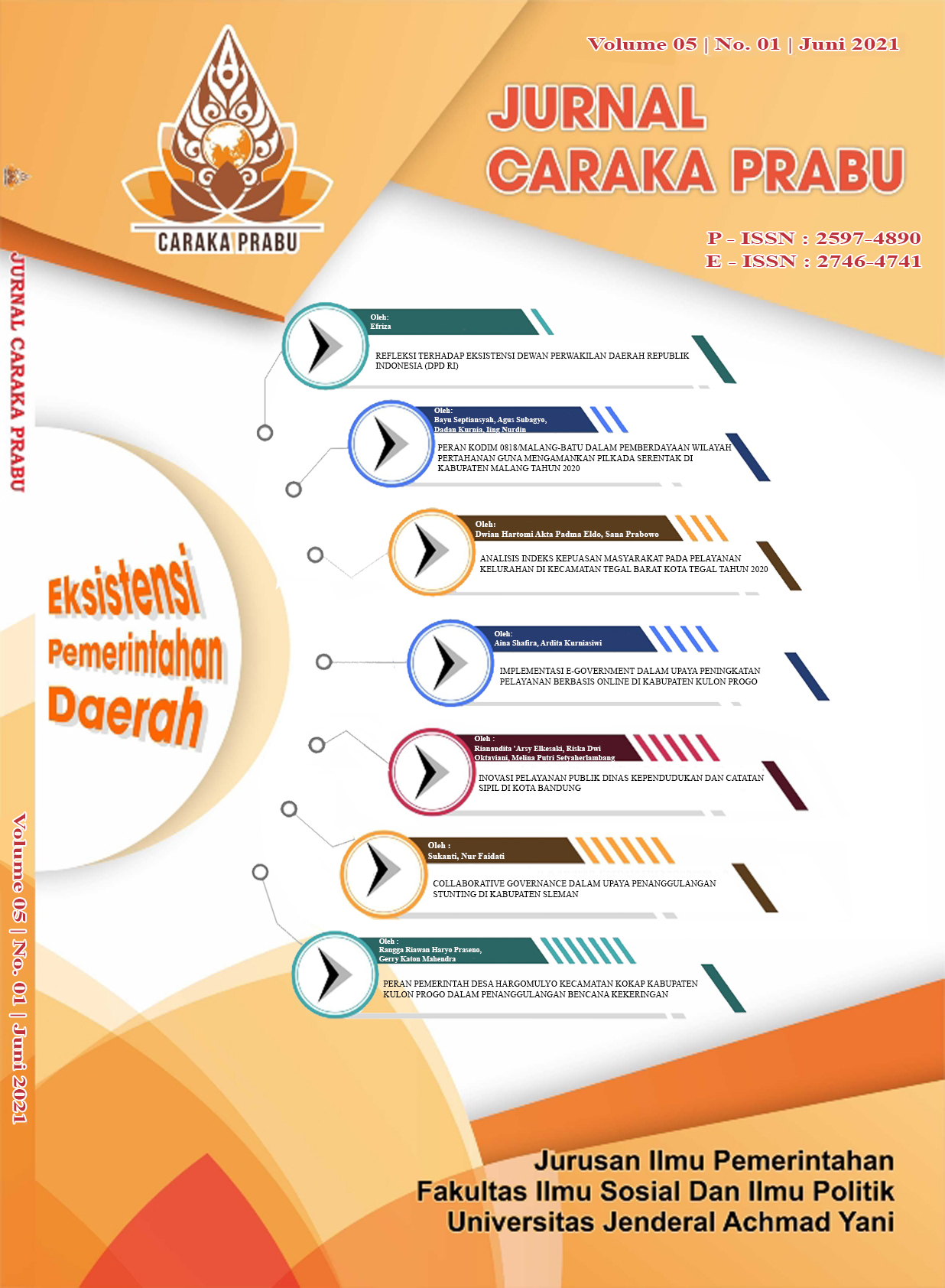
COLLABORATIVE GOVERNANCE DALAM UPAYA PENANGGULANGAN STUNTING DI KABUPATEN SLEMAN
Abstract
Stunting prevalence in Sleman district every year is decreased, in 2015 by 12,86%, in 2016 by 11,88%, in 2017 by 11,99%, in 2018 by 11%, and in 2019 by 8,38%. Stunting problems cannot be solved by one party, but it needs intervention from the other party. Therefore, the purpose of this research is to know the model of collaborative governance, the role of every stakeholder, and the institutional design in stunting prevention efforts in Sleman Regency. This study used qualitative research method. Data were obtained by interview techniques, observations, and documentation. Furthermore, the data analysis techniques used are data reduction, data presentation, and conclusion drawing. The results showed that the implementation of collaborative governance as measured by the dynamics of collaboration, namely principled engagement, shared motivation, and overall joint action capacity has been quite good, but some indicators have not gone well, namely the communication forum is not available specifically at the District Government level and still lack of private roles. Collaboration actions are in the form of innovation in preventing stunting activities, the implementation of which there are inhibitory factors such as rejection from the community, unhealthy environmental conditions, and the work of parents that affect parenting patterns in children as well as supporting factors such as human resources, natural resources, and budget. The impact of collaborative governance is the decrease in stunting rates and more educated communities. This collaboration resulted in an institutional design in the form of a pattern of accountability. Based on the results of the study, the author gave advice to the Sleman Regency Government in the form of the need to conduct monitoring and evaluation, increase the role of the private sector, strengthen all stakeholders' commitments, and improve coordination between stakeholders.
References
Choi, Taehyong. 2014. Revisitng The Relevance of Collaborative Governance to Korean Public Administration, The Korean Jurnal Of Policy Studies,. Vol 29. No. 2 . PP. 21-41.
Emerson, Kirk dkk,.2011. An Integrative Framework for Collaborative Governance, Oxford Universary Press on behalf of the Journal of Public Administration Research and Theory
Islamy,La Ode Syaiful. 2018. Collaborative Governance : Konsep dan Aplikasi. Yogyakarta : Deepublish.
Kementrian Kesehatan Republik Indonesia. 2018, Buletin Jendela Data dan Informasi Kesehatan : Situasi Balita Pendek (Stunting) di Indonesia. Jakarta: Pusdatin Kementerian Kesehatan RI
Kementrian Kesehatan Republik Indonesia. 2018. Riset Kesehatan Dasar tahun 2013 dan tahun 2018. Jakarta: Badan Penelitian dan Pengembangan Kesehatan Kementerian Kesehatan RI
Peraturan Daerah Kabupaten Sleman Nomor 6 Tahun 2019 Tentang Perubahan Kedua atas Peraturan Daerah Nomor 9 Tahun 2016 Tentang Rencana Pembangunan Jangka Menengah Daerah Tahun 2016-2021.
Peraturan Presiden Nomor 59 Tahun 2017 Tentang Pelaksanaan Pencapaian Tujuan Pembangunan Berkelanjutan
Purwanti, Nurul Dwi. 2016. Kebijakan Publik & Pemerintahan Kolaboatif : isu-isu Kontemporer (Colaborative Governance). Yogyakarta : Gava Media.
Ramayulis, Rita dkk. 2018, STOP Stunting dengan Konseling Gizi. Jakarta :Penebar Plus+ (Penebar Swadaya Grup)
Seigler, D., 2011. Renewing democracy by engaging citizen in shared governance. Public administration review
Sugiyono. 2016. Metode Penelitian Administrasi Dilengkapi dengan Metode R & D. Bandung: Alfabeta.
Sugiyono. 2017. Metode Penelitian Administrasi Dilengkapi dengan Metode R & D. Bandung: Alfabeta.
Aditya, Ivan. 19,8 Persen Anak di DIY Stunting.KR Jogja.com. 7 April 2018. https://www.krjogja.com/berita-lokal/diy/yogyakarta/198-persen-anak-di-diy-stunting/. Diakses pada 21 September 2020.
Copyright (c) 2021 Jurnal Caraka Prabu

This work is licensed under a Creative Commons Attribution-NonCommercial 4.0 International License.
Copyright Notice
The Authors submitting a manuscript do so on the understanding that if accepted for publication, copyright of the article shall be assigned to Jurnal Caraka Prabu, Department of Governmental Sciences, Faculty of Social and Political Science, Universitas Jenderal Achmad Yani as publisher of the journal.
Copyright encompasses rights to reproduce and deliver the article in all form and media, including reprints, photographs, microfilms, and any other similar reproductions, as well as translations.
Jurnal Caraka Prabu, Department of Governmental Sciences, Faculty of Social and Political Science, Universitas Jenderal Achmad Yani and the Editors make every effort to ensure that no wrong or misleading data, opinions or statements be published in the journal. In any way, the contents of the articles and advertisements published in Jurnal Caraka Prabu are the sole and exclusive responsibility of their respective authors.