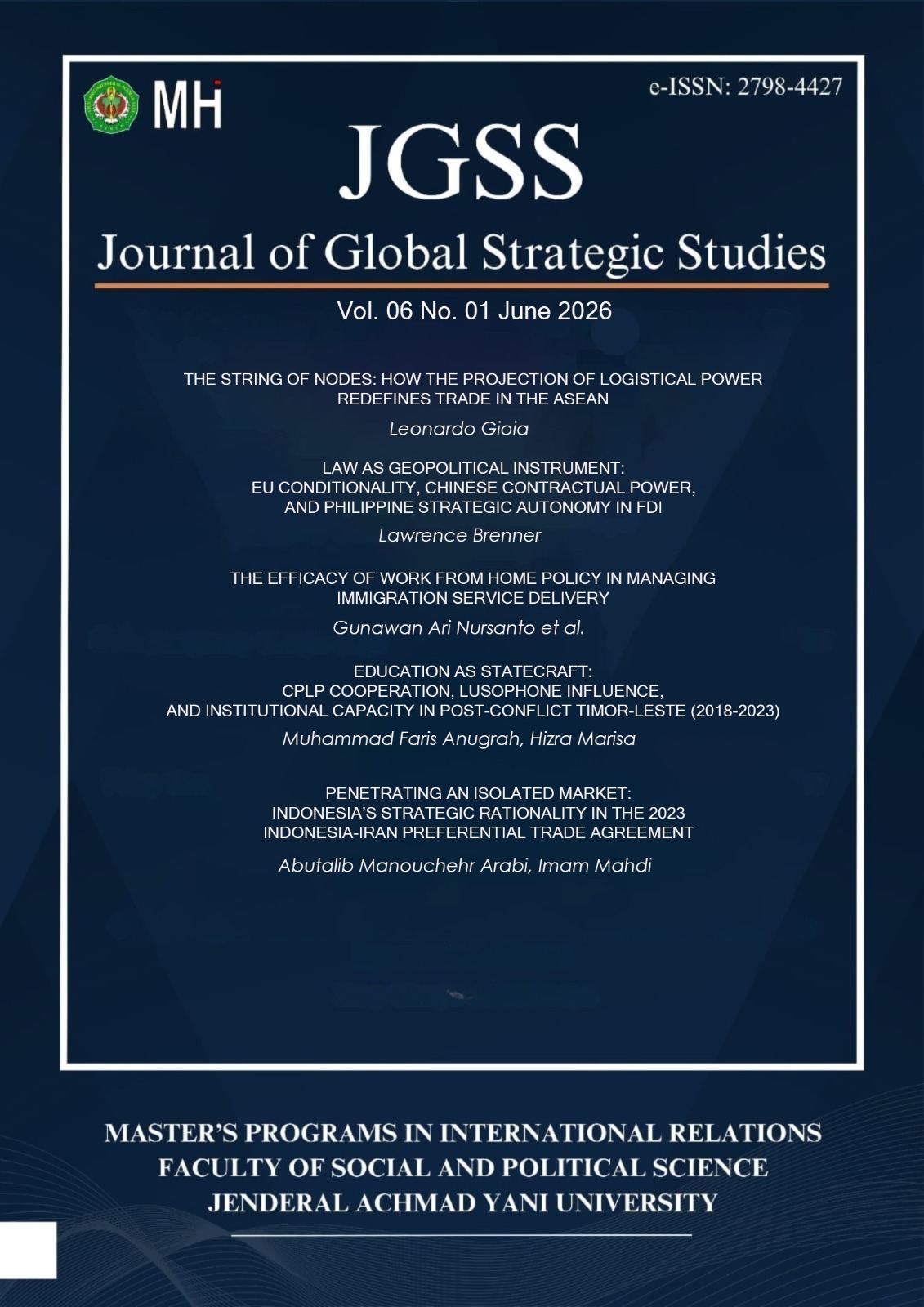
Education as Statecraft
CPLP Cooperation, Lusophone Influence, and Institutional Capacity in Post-Conflict Timor-Leste (2018-2023)
Abstract
Since gaining independence in 2002, Timor-Leste has faced structural challenges in strengthening national development, particularly in improving human resources through education. This study examines the contribution of the Comunidade dos Países de Língua Portuguesa in the education sector toward the improvement of Timor-Leste’s Human Development Index during 2018–2023. Using a qualitative-descriptive approach, this research relies on secondary data collected from official reports of United Nations Development Programme, United Nations Children's Fund, World Bank, CPLP documents, and relevant academic literature. Data were analyzed through document analysis and content analysis, focusing on educational access, teacher quality, and individual capability development. The findings show that CPLP has contributed positively through teacher training programs, curriculum development, technical assistance, scholarships, and academic mobility schemes. These initiatives strengthened Timor-Leste’s educational institutions and human capital formation. Empirically, Timor-Leste’s HDI increased from 0.606 in 2018 to 0.634 in 2023, indicating gradual progress in human development. From the perspective of liberal institutionalism, CPLP functioned as an international institution that facilitated cooperation, reduced capacity constraints, and promoted mutual gains. However, challenges remain, including dependency on external assistance, linguistic barriers, limited domestic bureaucratic capacity, and unequal distribution of educational benefits. Therefore, long-term success depends on Timor-Leste’s ability to strengthen domestic institutions and ensure inclusive educational development.
References
Books
Becker, G. S. 1964. Human capital: A theoretical and empirical analysis, with special reference to education, Columbia University Press, New York.
Bourdieu, P. 1986. ‘The forms of capital’ in Handbook of theory and research for the sociology of education, ed. J. Richardson, Greenwood Press, New York, 241–258.
Cardoso, F. H. & Faletto, E. 1979. Dependency and development in Latin America, University of California Press, Berkeley.
Castro Seixas, P., Canas Mendes, N. & Lobner, N. 2023. ‘ASEAN and Timor-Leste: An analysis of decision-making dynamics’ in Flowers in the wall: Truth and reconciliation in Timor-Leste, Indonesia, and Melanesia, ed. D. Webster, University of Calgary Press, Calgary, 47–71. https://doi.org/10.1163/9789004522923_005
Freire, P. 1970. Pedagogy of the oppressed, Herder and Herder, New York.
Ishtiaq, M. (2019). Creswell, J. W. (2014). Research Design: Qualitative, Quantitative and Mixed Methods Approaches (4th ed.). Thousand Oaks, CA: Sage. https://doi.org/10.5539/ELT.V12N5P40
Kay, Cristobal. (2005). André Gunder Frank: From the ‘Development of Underdevelopment’ to the ‘World System’. Development and Change. 36. 1177 - 1183. 10.1111/j.0012-155X.2005.00455.x. (https://www.researchgate.net/publication/229653302_Andre_Gunder_Frank_From_the_'Development_of_Underdevelopment'_to_the_'World_System')
Keohane, R. O. 1984. After hegemony: Cooperation and discord in the world political economy, Princeton University Press, Princeton.
Krippendorff, K. (2013). Content analysis: An introduction to its methodology (3rd ed.). SAGE Publications.
Soares, D. B., Paulino, V. & Ximenes, A. C. 2023. ‘The importance of the Community of Portuguese-Speaking Countries (CPLP)’ in Timor-Leste economic analysis, Universidade Nacional Timor Lorosa’e, Dili.
UNESCO. 2021. Reimagining our futures together: A new social contract for education, UNESCO, Paris.
World Bank. 2019. Timor-Leste poverty assessment, World Bank, Washington D.C.
World Bank. 2019. World development report 2019: The changing nature of work, World Bank, Washington D.C. https://doi.org/10.1596/978-1-4648-1328-3
World Bank. 2021. Timor-Leste economic report: Pathways to recovery, World Bank, Washington D.C.
Official Publications
Comunidade dos Países de Língua Portuguesa. 2007. Estatutos da Comunidade dos Países de Língua Portuguesa (revisão de Lisboa/2007), Secretariado Executivo da CPLP, Lisboa.
Comunidade dos Países de Língua Portuguesa. (2021). Manual da cooperação da CPLP (XLI RPFC). Secretariado Executivo da CPLP. https://esct.cplp.org/media/d0enl0hz/1_manual-cooperacao__aprovado.pdf
Freedom House. (2018). Freedom in the world 2018: Timor-Leste. https://freedomhouse.org/country/timor-leste/freedom-world/2018
Hessamian, F. Dependency and Development in Latin America. https://www.academia.edu/44800964/Dependency_and_Development_in_Latin_America
Organisation for Economic Co-operation and Development. (2025). Development co-operation profiles: Portugal (pp. 1–28). OECD Publishing. https://doi.org/10.1787/550fb40e-en
United Nations. 2023. SDG country profile: Timor-Leste, United Nations, New York.
United Nations Children’s Fund. 2018. Education in Timor-Leste: Country report, UNICEF, New York.
United Nations Development Programme. 2018. Human development report 2018: Timor-Leste, UNDP, New York.
United Nations Development Programme. 2023. Human development report 2023/2024: Breaking the gridlock, UNDP, New York.
Copyright (c) 2026 Journal Of Global Strategic Studies

This work is licensed under a Creative Commons Attribution-NonCommercial 4.0 International License.
Copyright Notice
The Authors submitting a manuscript do so on the understanding that if accepted for publication, copyright of the article shall be assigned to Journal of Global Strategic Studies, Department of Master of International Relations, Faculty of Social and Political Science, Universitas Jenderal Achmad Yani as publisher of the journal.
Copyright encompasses rights to reproduce and deliver the article in all form and media, including reprints, photographs, microfilms, and any other similar reproductions, as well as translations.
Journal of Global Strategic Studies, Department of Master of International Relations, Faculty of Social and Political Science, Universitas Jenderal Achmad Yani and the Editors make every effort to ensure that no wrong or misleading data, opinions or statements be published in the journal. In any way, the contents of the articles and advertisements published in Journal of Global Strategic Studies are the sole and exclusive responsibility of their respective authors